Ducts
Small tubes that carry milk toward the nipple. Many breast cancers begin here.
Breast cancer develops when cells in breast tissue begin growing uncontrollably. These abnormal cells can form a tumor. Some breast cancers can invade nearby tissue and may spread to other parts of the body. Cancer can develop in one or both breasts and can affect women and men. Early detection and appropriate treatment can improve outcomes.
Small tubes that carry milk toward the nipple. Many breast cancers begin here.
Glands that produce breast milk. Cancer beginning here is called lobular cancer.
The breast also contains fatty and connective tissue, blood vessels, and lymph vessels.
Breast cancer is a group of diseases. Understanding how it begins and spreads can help people make informed decisions about breast health.
Anyone with breast tissue can develop breast cancer. It is much more common in women, and risk generally rises with age, but younger adults and men can also be affected. Many people diagnosed with breast cancer have no known family history.
Changes in a breast cell’s DNA can disrupt the instructions controlling cell growth and repair. Abnormal cells may keep dividing or survive when they should die, sometimes forming a tumor. Most DNA changes are acquired during life rather than inherited. The exact cause in an individual is often unknown.
Cancer cells can multiply, invade nearby tissue, and travel through blood or lymph vessels to distant sites. This spread is called metastasis. Hormones and growth signals can encourage some tumors to grow. Lymph-node testing helps doctors assess spread.
Being familiar with how your breasts normally look and feel can help you notice a new or persistent change.
A new depression, puckering, or indentation in the breast skin.
A noticeable new lump in the breast or underarm area.
A new nipple inversion, change in position, or unusual appearance.
Unexpected nipple discharge or another persistent nipple change.
Persistent redness, swelling, rash, or a change in skin texture.
A new, unexplained change in the size, contour, or shape of a breast.
Use self-awareness to become familiar with your normal. It does not replace mammography or other professional screening recommended for you.
If you menstruate, breasts may feel less tender about a week after your period. If you do not menstruate, choose a consistent day if you want a regular self-check routine.
Observe your breasts with your arms relaxed. Notice any new difference in shape, skin, or nipple appearance.
Look again with your arms raised and check for new dimpling, pulling, swelling, or other visible changes.
Be aware of a new lump, swelling, or thickening in the underarm area.
If you self-check, systematically cover the breast area and notice anything that feels new or different from your normal.
If you notice something new or concerning, consult a qualified healthcare professional instead of trying to diagnose it yourself.
Having a risk factor does not mean a person will develop breast cancer. Some factors cannot be changed, while others relate to health and lifestyle.
Risk increases with age and is higher in women, although men can also develop the disease.
Breast or ovarian cancer in close relatives can increase risk. Inherited changes in BRCA1, BRCA2, and other genes may raise risk and can come from either parent. A clinician can advise whether genetic counseling is appropriate.
A previous breast cancer diagnosis and certain abnormal breast conditions, including atypical hyperplasia and LCIS, can increase future risk.
Dense breasts are associated with higher risk and can make cancers harder to see on mammograms. Ask your clinician how density affects your screening plan.
Earlier periods, later menopause, a later first full-term pregnancy, or not having given birth can influence risk through hormone exposure. These factors do not determine whether someone will get cancer.
Regular physical activity can help lower risk. Choose activity that suits your ability and health.
Excess body weight after menopause is associated with increased risk. A balanced diet and healthy weight support overall health; no particular food prevents breast cancer.
Alcohol increases breast cancer risk. Greater intake is associated with greater risk; limiting or avoiding it reduces this exposure.
Radiation treatment to the chest, especially at a young age, can increase later risk. This is a medical exposure rather than an inherited trait or a personal lifestyle choice.
Combined estrogen and progestin therapy can increase risk. Discuss benefits, risks, and alternatives with your prescriber.
Instead of using one schedule for everyone, screening should be based on age, personal history and individual risk.
Be familiar with the usual look and feel of your breasts so you can recognize a new or persistent change.
Report a new lump, skin or nipple change, unusual discharge, or other persistent concern.
Discuss mammography and other screening with a qualified healthcare professional based on your individual risk.
These faceless human illustrations show the body position, arms and breast area clearly. They are educational visuals only and do not replace professional screening.
If you choose to self-check lying down, support your shoulder comfortably and relax the breast area.
Use several finger pads together and feel gently instead of poking with fingertips.
Look at both breasts and notice a new difference in size, shape, skin or nipple appearance.
If you self-check, use a consistent up-and-down pattern so you become familiar with the whole breast area.
Notice a new lump, swelling or thickening in the underarm area.
Check for a new pulling, dimpling, swelling or visible change. Report persistent changes to a healthcare professional.
If you self-check, use comfortable pressure rather than pressing hard enough to cause pain.
Screening looks for possible signs of breast cancer before symptoms appear. Mammography is an X-ray examination of breast tissue. Ultrasound and MRI may also be used in particular situations.
Screening recommendations vary according to age, personal history, family history, and individual risk. Discuss an appropriate screening plan with a healthcare professional.
Add a screening reminder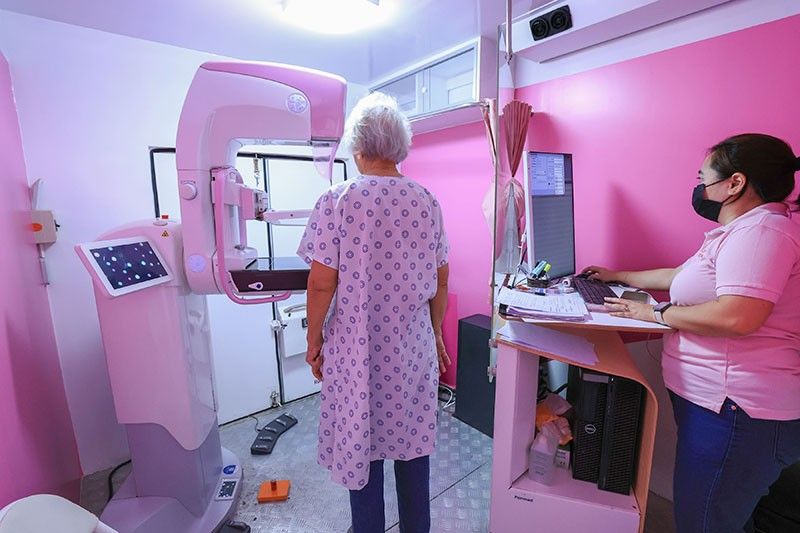

SusoPorta brings breast-health education closer to Filipino families through clear information, supportive reminders, and trusted resources.
Types are described by where cancer starts, whether it invades nearby tissue, and its biomarkers. These descriptions can overlap: a tumor may be both invasive ductal and triple-negative. Type and stage are different.
Abnormal cells remain inside the milk ducts without invading surrounding breast tissue. DCIS is non-invasive, or stage 0, breast cancer. It often causes no symptoms and is found on a mammogram. Some DCIS can become invasive, so evaluation and a care plan are important. “In situ” means “in its original place.”
IDC starts in a milk duct and grows into surrounding breast tissue. It is the most common invasive breast cancer and can spread to lymph nodes or distant organs. Treatment depends on stage and biomarkers, rather than the name alone.
ILC begins in the milk-producing lobules and invades nearby tissue. It may cause thickening or a change in breast shape rather than a distinct lump, which can make detection more difficult. Additional imaging may be needed based on a clinician’s assessment.
TNBC tests negative for estrogen receptors, progesterone receptors, and HER2 positivity. It can grow more quickly than some other cancers. Hormone therapy and standard HER2-directed treatment do not target these features, but chemotherapy and, in selected cases, immunotherapy or other medicines may be used.
This uncommon, fast-growing cancer blocks lymph vessels in the breast skin. Rapid swelling, redness or discoloration, warmth, orange-peel skin, or nipple inversion can occur without a distinct lump. Seek prompt medical assessment for these changes. The name describes its appearance, not an infection.
MBC is breast cancer that has reached distant organs, such as the bones, lungs, liver, or brain. It is stage 4. It may be present at first diagnosis or develop later. Cancer in these organs remains breast cancer because it originated in breast cells.
LCIS is a condition involving abnormal cells in the lobules. It is not invasive breast cancer and is not staged as breast cancer. It signals an increased risk of future breast cancer, so a clinician may recommend closer monitoring or risk-reduction options.
Biopsy and biomarker tests help identify which treatments may work. Hormone receptor-positive cancer has estrogen and/or progesterone receptors; HER2 status is tested separately. The healthcare team also considers stage, tumor grade, overall health, and personal preferences.
A diagnosis cannot be made simply by feeling a lump. Healthcare professionals may use clinical evaluation, imaging and, when needed, a biopsy. A biopsy removes a tissue sample for examination. A benign result means cancer was not found in the examined tissue; malignant means cancer cells are present.
Stage describes the extent of cancer. Doctors consider tumor size, lymph nodes, distant spread, tumor grade, and ER, PR, and HER2 results. The examples below describe simplified anatomical staging; the final prognostic stage may differ.
DCIS stays within the milk ducts and has not invaded surrounding breast tissue. Care aims to treat the affected area and reduce the chance of invasive cancer developing.
In simplified anatomical staging, stage 1A is a tumor no larger than 2 cm without lymph-node spread. Stage 1B involves tiny deposits in nearby nodes, larger than 0.2 mm but no larger than 2 mm, with no breast tumor found or a tumor no larger than 2 cm.
Anatomical stage 2A can involve no identifiable tumor or a tumor up to 2 cm with cancer in 1–3 underarm nodes, or a tumor larger than 2 cm but no larger than 5 cm without node spread. Stage 2B can involve a tumor larger than 2 cm but no larger than 5 cm with 1–3 affected nodes, or a tumor larger than 5 cm without node spread.
Cancer has more extensive spread to nearby lymph nodes and/or the breast skin or chest wall, without distant metastasis. Substages 3A, 3B, and 3C describe different patterns. Inflammatory breast cancer is stage 3 unless distant spread makes it stage 4.
Cancer has spread to distant organs or distant lymph nodes. Treatment generally aims to control cancer, relieve symptoms, and support quality of life. It is usually not curable, but treatments can help people live longer; response varies for each person.
Early cancer can have no symptoms. A lump, nipple discharge, dimpling, swelling, or skin change can occur at different stages and also with non-cancerous conditions. Tests are needed to diagnose and stage cancer. Recurrence can be local, regional, or distant; only distant recurrence is metastatic.
There is no single treatment plan for everyone. A healthcare team considers the cancer's characteristics, stage, overall health, and individual circumstances.
May include lumpectomy or mastectomy depending on the clinical situation.
Uses high-energy radiation to treat cancer cells in a targeted area.
Uses medicines that travel through the body to destroy or control cancer cells.
May be used for cancers that are sensitive to hormones.
Targets particular characteristics involved in the growth of certain breast cancers.
May help the immune system recognize and attack certain breast cancers.
Men have breast tissue and can develop breast cancer. Although it is uncommon, a new breast or nipple change should be taken seriously.
A firm lump, often near the nipple, nipple discharge or inversion, skin dimpling, a persistent nipple rash or sore, and an underarm lump need medical assessment. A lump may be painless. Do not wait for pain before seeking help.
Older age, a close family history, inherited BRCA changes, previous chest radiation, and conditions or treatments that alter hormone levels can increase risk. These can include Klinefelter syndrome, liver disease, and estrogen-containing treatment. Discuss personal risk with a clinician.
Evaluation may include examination, imaging, and biopsy. Men use the same breast cancer staging system. IDC is common, and many male breast cancers are hormone receptor-positive. Surgery, radiation, and medicines are selected according to the individual diagnosis.
Educational content on this page is paraphrased from ICanServe Foundation, American Cancer Society, Breastcancer.org, the World Health Organization, and the National Cancer Institute.
Read more: Causes and risk factors · Types · Stages · Breast cancer in men.